
Harting Black


Meet John, the Downland Shepherd of more than 40 years who developed the Harting Black Breed.
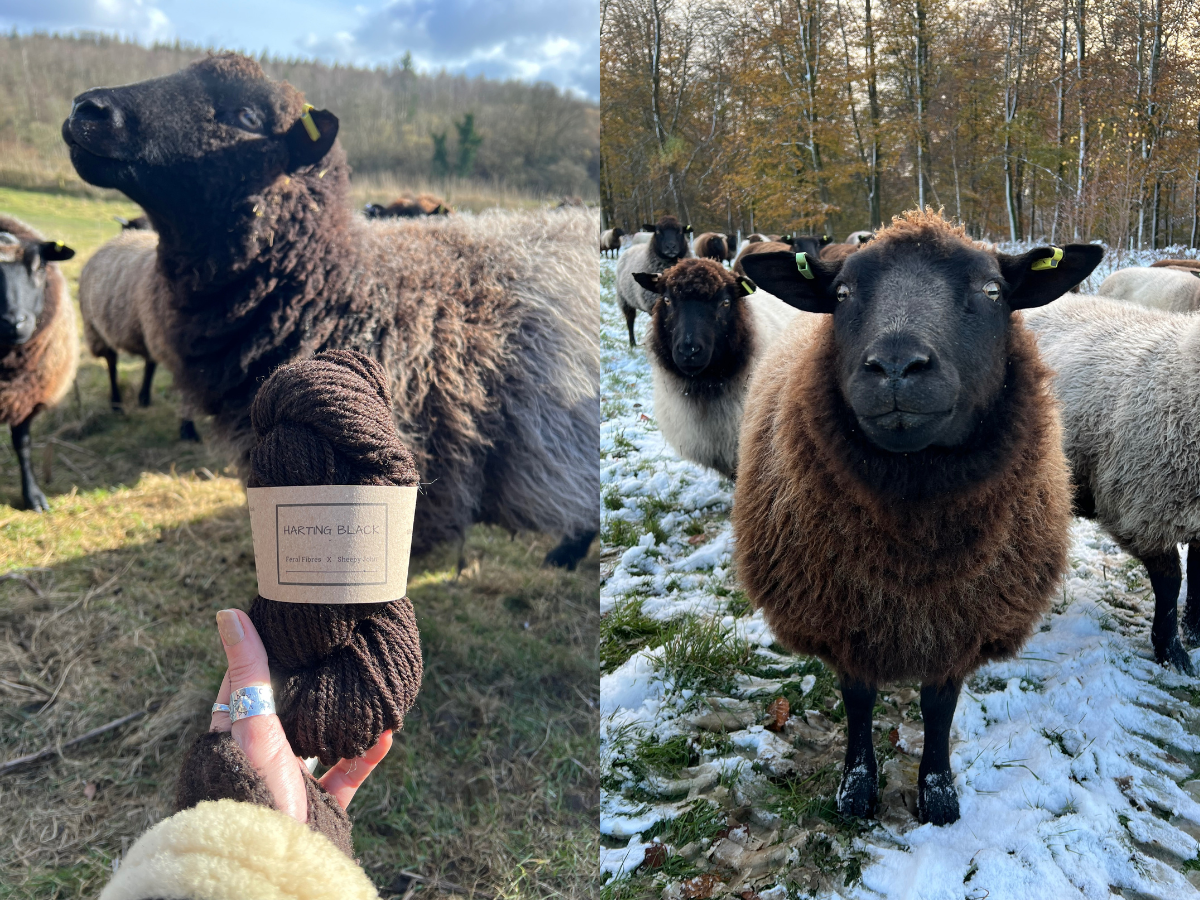
Harting Black began from 5 different hand-selected breeds, including Zwartbles and Swaledale, with John's objective to focus on breeding sheep with wonderful personalities and temperaments. To achieve this, John continued to cross breed starting with individual sheep in their most primitive and wild state with natural instincts for survival.
Years later, John has produced a fine and extravagant flock, producing meat with exceptional flavour alongside a view to create many different superior wool types.
The Harting Black have now evolved into a breeding flock in excess of over 200 with followers and young stock, with the intention to expand the flock in the spring of 2026. All sheep are watched over by John's best friend, the ever loyal Flynn the sheepdog.
(Pictured above, John the Shepherd surrounded by a few of the Harting Black sheep up on the hillside. Wearing a handspun and handwoven waistcoat using Dark Brown Harting Black yarn created by Feral Fibres. The second shot is of Flynn the sheepdog, sat patiently by the Mule waiting for the next command)

'My present objective is to produce a variety of beautiful sheepskins that delight me beyond compare. Now with the input of Torie at Feral Fibres, I'm able to watch my fabulous fleece come to fruition in many more forms'. - Sheepy John
Torie met John by chance back in the summer of 2022 at a local fayre, but in just one meeting they recognised a shared love and interest in sheep and the fibre they produce. Torie spent many weeks at the farm learning more about the welfare of the sheep and their lifecycle. Harting Black began from 5 different hand-selected breeds, including Zwartbles and Swaledale, with John's objective to focus on breeding sheep with wonderful personalities and temperaments. To achieve this, John continued to cross breed starting with individual sheep in their most primitive and wild state with natural instincts for survival.
Years later, John has produced a fine and extravagant flock, producing meat with exceptional flavour alongside a view to create many different superior wool types.
The Harting Black have now evolved into a breeding flock in excess of over 200 with followers and young stock, with the intention to expand the flock in the spring of 2026. All sheep are watched over by John's best friend, the ever loyal Flynn the sheepdog.
(Pictured above, John the Shepherd surrounded by a few of the Harting Black sheep up on the hillside. Wearing a handspun and handwoven waistcoat using Dark Brown Harting Black yarn created by Feral Fibres. The second shot is of Flynn the sheepdog, sat patiently by the Mule waiting for the next command)
'My present objective is to produce a variety of beautiful sheepskins that delight me beyond compare. Now with the input of Torie at Feral Fibres, I'm able to watch my fabulous fleece come to fruition in many more forms'. - Sheepy John
They are livestock on a working farm, but from the moment they are born to the moment they depart they are treated with the utmost kindess, affection and respect.
Almost every part of the animal is utilised and minimal waste is ensured. Being as ethical as possible is a large part of the ethos behind Feral Fibres, with natural products and local British Wool as the main focus.
(Pictured above, a selection of Harting Black sheepskins showing the variety of colour and texture the sheep produce. The second photo shows a selection of natural Harting Black Sliver produced at the mill)
As far back as the Stone Age around 10,000BCE, people have been working with wool.
Due to wool's decomposable nature, wool garments from thousands of years ago are rare to find today. However, many samples have been discovered from archaeological digs in bogs across the UK and Europe.
Due to wool's decomposable nature, wool garments from thousands of years ago are rare to find today. However, many samples have been discovered from archaeological digs in bogs across the UK and Europe.
The oxygen-poor and acidic conditions found on bogs make the perfect combination to preserve organic materials.
For a long time, present day farmers were unable to adequately profit from fleece due to haulage costs and unfortunate low wool prices. Although wool prices have seen an increase recently, haulage prices and other outgoing costs such as the price of food and welfare products have also increased meaning this in an ongoing battle to showcase the beauty and benefits of natural wool products.
The value of wool goes beyond profit, not only is it a vital source of clothing, but as a biodegradable fibre it's much kinder to the planet.

The value of wool goes beyond profit, not only is it a vital source of clothing, but as a biodegradable fibre it's much kinder to the planet.
Torie has spent the last few years working closely alongside John collaborating on ideas to increase the popularity of the Harting Black fleece.
Towards the end of 2024, both Torie, John and Flynn travelled down to Dorset to deliver over 30kg of raw fleece with the intention of having the majority spun into three natural shades of Double Knit and Aran weight yarn.
Another part of Feral Fibres values is being mindful of our overall carbon footprint, so it was vital to find a mill within reasonable distance. Our closest, and also top choice, was David and Ruth at Rampisham Hill Mill.
'This wool is in the top 5% of fleece we've processed here at the mill' - David Wilkins, Rampisham Hill Mill
(Pictured above is the washed Harting Black fleece travelling through the industrial carder before being processed into sliver. The second photo shows the yarn at high speed being spun onto bobbins/cones)

At present, Feral Fibres stocks a variety of mill processed products including out best selling DK and Aran weight yarn which is semi-worsted spun. Alongside a selection of natural carded sliver, felt items, raw fleece and a large collection of sheepskins. All from the wonderful Harting Black flock.
Your support helps multiple people involved in this process, but more importantly the Harting Black sheep and the continued work by John are getting the recognition they deserve.
(Pictured above, three shades of Harting Black sliver being processed into yarn at the mill. The second photo is a styalised shot of a 100G skein of Light Grey Aran weight Harting Black yarn and a knitted swatch)
 (Pictured above, the Bronze Age Burial mounds the Harting Black graze next to. The second photo shows three Harting Black sheep on the otherside of the mounds)